Flashback. FIDA World Cup 2025 : The World’s Quest to be Mondial Crowned
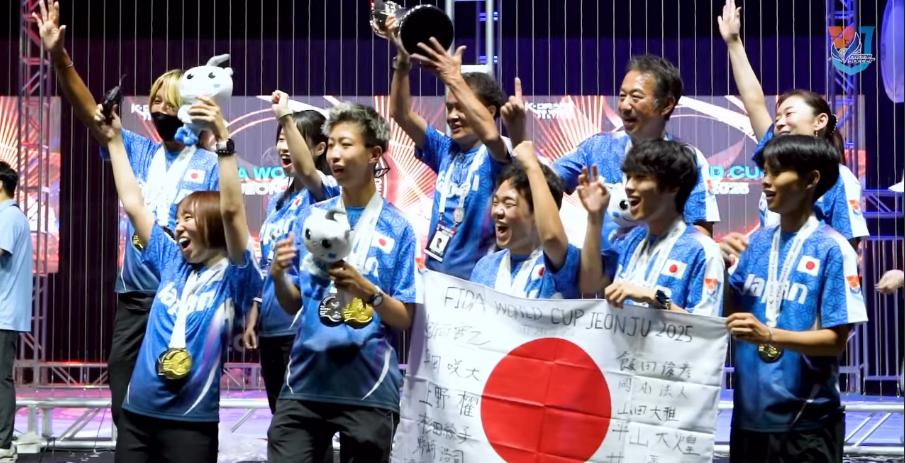
Japan was one of the key players in this inaugural FIDA World Cup, winning the Class 20 International division and reaching the finals in the Class 20 Club Challenge © JapanDroneSoccer
In September 2025, the Korean City of Jeonju, the birthplace of modern Drone Soccer, hosted the very first FIDA World Cup. It was a revolution and, above all, a major milestone for the growth of Drone Soccer worldwide, marked by the participation of 33 countries.
While international competitions had previously been held under the name “Club Challenge,” this time the stakes were entirely different: playing for a country, a flag, a nation… Between Class 20 and Class 40, no fewer than 33 countries competed for the world title. It was an opportunity to gauge everyone’s level, from the Asian pioneers to the newcomers from the West. But beyond the competitive aspect, this World Cup was above all an opportunity for FIDA to think big and showcase the potential of Drone Soccer to the world.
Global Digital Visibility
On-site, everything is in place to follow the matches up close at the “SkyFence.” Announcers, scoreboards, and broadcast desks. In short, everything needed to provide spectators on-site with as much information as possible, whether they’re new to the sport or not. But for a World Cup, the most important thing is being able to follow the competition from anywhere in the world. And in 2025, what better way to undertake this project than through the internet ? Following the example of the world’s biggest sporting events, the FIDA has set up a digital hub to follow the competition live : live scores, broadcasts of the matches and the opening ceremony, the tournament bracket, and even player profiles tailored to each team and each player…
A Spectacle Above All
To mark the occasion, it’s safe to say that Korea has gone all out for this first World Cup, with one goal : to turn Drone Soccer into a spectacle. Ambitions that may seem excessive at first glance, until you realize that the culture of Drone Soccer didn’t originate in Korea for nothing. Using the Jeonju World Cup Stadium for a grand opening ceremony. A parade, musical performances, mascots on site, activities, and above all, Free Play to allow all visitors to try their hand at Drone Soccer on the sidelines of the competitions.
And what about the competition?
Speaking of competition, what are the key takeaways from this World Cup in terms of sports ? First of all, that the Koreans, the pioneers of the sport, are still a step ahead of the rest of the field. World champions in the Class 40 category—and with a very young team at that—Korea must nonetheless be wary of the rising power of the Japanese delegation. Although they fell short in the Class 40 final, the Japanese achieved the feat of defeating South Korea on their home turf in Jeonju—where it all began nearly 10 years ago—in the Class 20 category. On the European side, we must not forget Spain’s excellent performance, finishing 4th in the Class 40 category and losing to Singapore in the third-place match, or the quarterfinal appearances by France and Turkey. On the American side, while the United States failed to advance past the group stage in Class 20 and 40, Mexico represented the Pan-American continent admirably, as the sole non-Asian team to reach the Class 20 quarterfinals.
A few months later, this first FIDA World Cup stands as a model for other nations eager to organize new competitions at the national, continental, or international level. Whether in terms of communication, event management, or competition, this event was a true local success, laying the foundation for this new era of Drone Soccer.