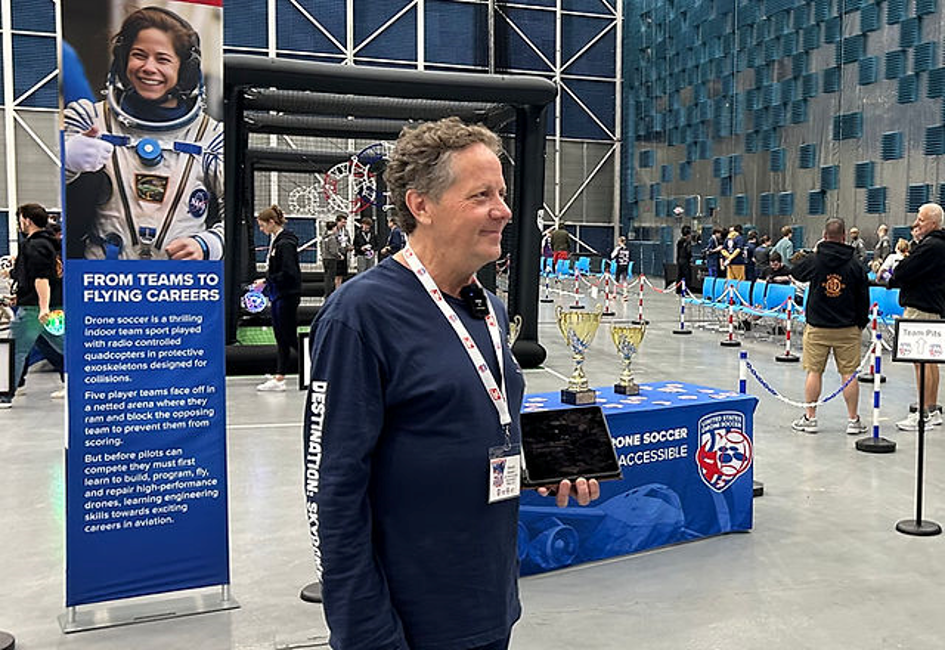
David Roberts: “The FAI is the most mature aspect of drone soccer.”
As president of USDroneSoccer and a key member of the FAI, David Roberts fully embodies the development of drone soccer in the United States. But in a landscape where competition with FIDA USA and Tim Ingram is the norm, collaboration between the two organizations remains difficult. So, which organization has the most legitimate drone soccer program? Is it really the same development model? We met with David Roberts…
The US Drone Soccer Association (USDSA) is currently the organization that has most effectively structured drone soccer in the United States. Its approach is unique: it doesn’t just organize competitions; it uses Drone Soccer as a tool to develop STEM (Science, Technology, Engineering, and Mathematics) skills, guide young people toward careers in aeronautics, and create educational pathways for youth. Recognized by the Academy of Model Aeronautics as an interest group for F9A Drone Soccer and affiliated with the FAI sports movement, its mission is to introduce middle and high school students to aviation, robotics, programming, and teamwork. Their philosophy is summed up by four verbs: Build, Code, Fly, Compete. In other words, students don’t just receive a drone—they learn how to assemble it, configure it, repair it, and improve its performance, all with the goal of becoming competitive.
“The most mature aspect of Drone Soccer”
This is perhaps the biggest difference between FIDA’s regulations and those of the FAI. While FIDA and its Korean model focus their development on education, piloting, and fairness, the FAI prioritizes more complex criteria. In the F9A-A and F9A-B categories, each pilot builds, programs, and optimizes their own drone: “I have a lot of respect for what the FIDA does; even though communication with Tim Ingram is complicated, their development is hardly comparable to ours. In Korea, every drone is similar; the FIDA sells only one type of drone and is aimed primarily at a very young audience. On our end, the FAI is perhaps the most mature organization in drone soccer and caters to a slightly older audience. Here, we receive our drone in parts, and it’s up to us to assemble it from scratch, program it, and optimize its performance and impact resistance. This also creates an added sense of satisfaction, especially for young students—it’s an opportunity to tell their parents, “Look! I’ve finished building my drone,” and that’s priceless. “The pilot is 100% in control of their machine,” declares the president of USDroneSoccer with a certain pride.
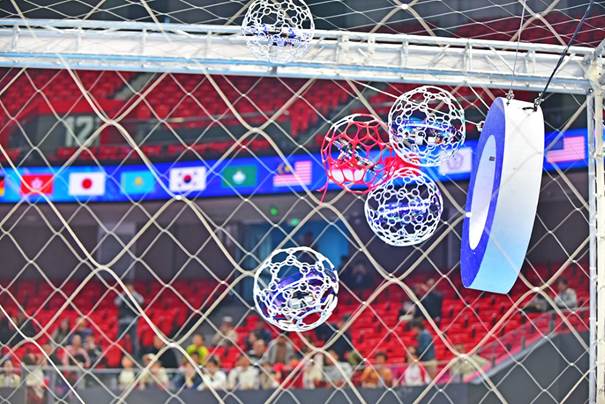
2026 U.S. Drone Soccer National Championship
Dubbed “Battle at the Beach,” the National Championship, held on May 18 and 19, 2026, on the campus of Embry-Riddle Aeronautical University in Daytona Beach, was the must-see event of the year. But why Embry-Riddle? “Often regarded as one of the leading universities in the fields of aeronautics, aviation, and unmanned aerial systems, hosting this championship was the best way to show young pilots that a passion for drone soccer can also pave the way toward studies in engineering, piloting, aircraft maintenance, or autonomous technologies,” explains David Roberts
This edition brought together the top 24 American teams, which qualified through district championships held across the country. This is a major achievement for David Roberts, who has clearly observed the rise in the national level of play since last year: “In just one year, this competition has taken on a whole new dimension and generated a whole new level of enthusiasm. Beyond representing a team, these young people represent their school, their campus, and their district in a setting that pushes them to excel.”
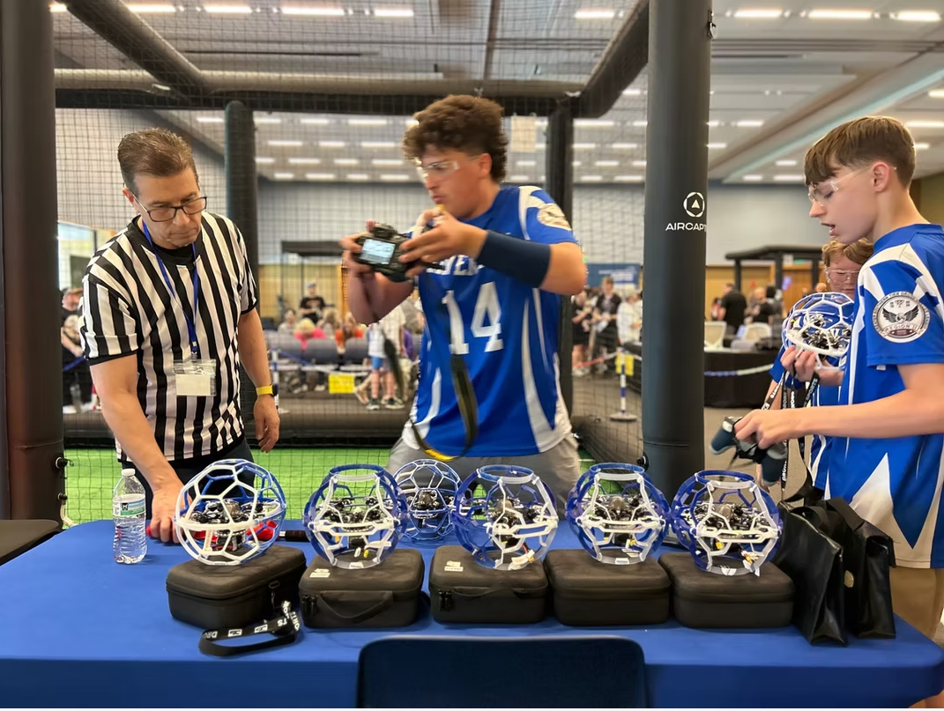
A Spot on Team USA
Beyond the national title, the main goal was to secure a spot on Team USA. The champion team earns points with USDroneSoccer to represent Team USA internationally in FAI competitions. It’s an honor for David Roberts, who has been watching his teams’ progress up close: “Since the start of the International Series season, we’ve held our own against the major drone soccer nations under the FAI. Whether it’s Germany, China, Turkey, or even France—which, in my opinion, is the most promising team and one we’ll need to keep an eye on in the coming years. In any case, several months after the World Cup, we’re still performing at a high level, which is reassuring given the major events coming up in 2027.”