
We asked 9 questions to Lee Bumsu, Founder of Korean Drone Soccer
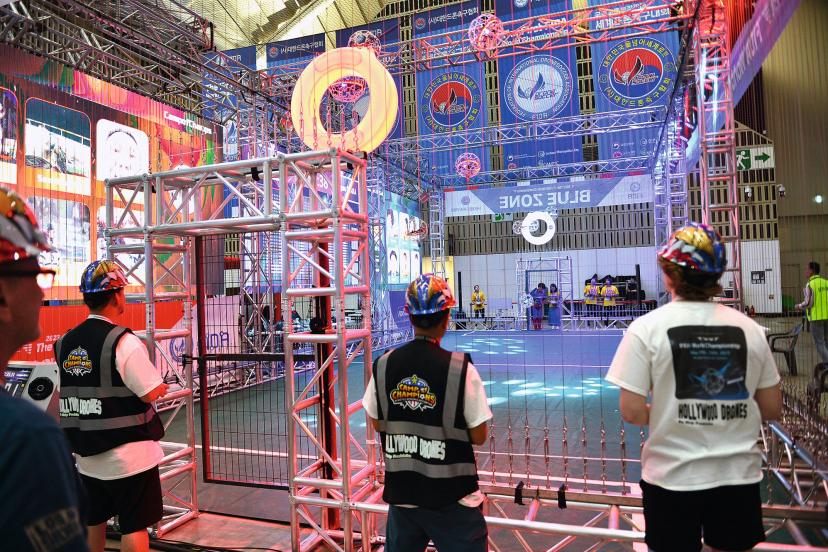
South Korea — On a spectacular field dotted with metal structures and glowing rings, American players compete in an international match © Lee Bumsu
Famous for its tourism, festivals, and culinary specialties, the city of Jeonju is, above all, the birthplace of Drone Soccer, as conceived by FIDA. It was here in 2015 that Lee Bumsu laid the foundation for what is now modern Drone Soccer. Between a passing fad, educational needs, soccer’s influence, and a shared market, here is the full story of « Made in Korea » Drone Soccer.
Before Drone Soccer was created, what was your connection to drones and soccer, and how did you come up with the idea of turning it into a sport ?
Before Dronesoccer, various types of remotely controlled aircraft, including helicopters, airplanes, and drones, existed primarily as individual hobbies rather than organized team sports with standardized rules. Around 2015, as consumer drones became increasingly popular, a variety of game-oriented drones entered the market. One thing they all had in common was that they were designed to avoid collisions, and many included emergency-stop functions in case a collision occurred. At the time, the concept of a drone specifically designed to collide with other drones simply did not exist. I became interested in developing drones intended for controlled collision. While designing such machinery, I adopted a protective outer frame inspired by the structure of a Fullerene C60 molecule. Interestingly, its shape closely resembled a soccer ball. Like many people, I have always been a soccer fan. My family has also been a long-time supporter of the Jeonbuk Hyundai Motors football club based in Jeonju, Korea. In the early days, many people told me that the name “Dronesoccer” was not appropriate and suggested alternative names. However, because both the drone technology and the game itself were unfamiliar to the public, I believed the name should be as familiar and accessible as possible. That is why I insisted on calling it “Dronesoccer ».
What was the process of creating the FIDA ?
The journey began with the development of the drone ball itself and the formation of small groups that eventually became the first Dronesoccer teams. Our activities attracted considerable attention from international media, many of whom viewed Dronesoccer with curiosity in first. When we were invited to demonstrate Dronesoccer at large international exhibitions attended by global media outlets, journalists frequently compared it to the game of Quidditch from Harry Potter. This comparison generated significant media coverage around the world. Before establishing FIDA, we first created KDSA (Korea Dronesoccer Association). Through KDSA, we organized teams across Korea and began hosting regular national competitions in 2017. As international interest continued to grow, people from various countries began visiting KDSA to learn how Dronesoccer could be introduced in their own regions. Over time, it became clear that KDSA alone was not sufficient to support the systematic international expansion of the sport. I therefore reached out to many people around the world who shared an interest in Dronesoccer and proposed the creation of FIDA. My goal was to establish an international organization capable of systematically promoting, organizing, and developing Dronesoccer worldwide.
Why is this tech-sport perfectly suited for Korean society and Asian society in general ?
I have never viewed Dronesoccer as a sport that is inherently better suited to Asia than to other parts of the world. However, Dronesoccer is currently more developed in Korea, and geographically nearby Asian countries have found it easier to adopt the related systems and infrastructure. Countries farther away, particularly in Europe and other regions, often face challenges related to logistics, transportation costs, and building human networks. While these obstacles remain, I believe they will gradually improve over time. Beyond geography, one advantage shared by many Asian countries is the rapid growth of the civilian drone industry. In particular, drones have been widely adopted in agriculture and commercial service sectors. Asian people have become more familiar and comfortable with drone technology. This familiarity naturally creates a favorable environment for the growth of Dronesoccer.
Many people view Drone Soccer as an educational tool : were you aware of this impact from the start ?
There has always been strong demand for drone education. However, integrating drones into education presents several challenges. In most schools, one teacher must manage many students at the same time, and teachers themselves may not have extensive knowledge or experience with drones. Safety concerns and the broad scope of drone technology make comprehensive instruction difficult. As a result, drone education in schools has often been limited to introductory presentations or simple assembly activities using toy-like drones. These programs were usually one-time experiences rather than sustainable educational models. However, Dronesoccer offers several advantages as an educational tool. Compared with many other types of drones, it is better suited for structured learning environments. It’s a team sport, and naturally fits within the organizational framework that already exists in schools.
To expand participation, we developed smaller and safer Dronesoccer standards specifically designed for students and began actively promoting the sport within educational institutions. This effort ultimately led to the creation of the Class40 and Class20 categories. Today, most Dronesoccer activities conducted in schools utilize the Class20 drone ball standard. In educational settings, safety must always be the highest priority. For this reason, we limit the maximum weight of a Class20 drone ball to 110 grams in order to minimize the risk of injury and prevent the use of potentially hazardous equipment. Education systems vary from country to country and are generally managed within the public sector. Because each nation has different educational structures and requirements, FIDA focuses on collecting, sharing, and promoting successful examples of Dronesoccer integration within schools across its member countries.
I believe that safety and standardization are the two most important factors for the long-term success of Dronesoccer in education. As long as common standards and safety regulations are maintained, schools can easily host competitions and events, creating more opportunities for students to participate and helping the sport continue to grow.
From a sporting perspective, you organized the first World Cup in Korea in 2025. What were the various stages, events, and meetings that led to such a major event ?
Organizing a large-scale international sporting event around a single sport is never easy. It requires a significant number of participating teams, substantial financial resources, and a large group of specialized professionals working together. Perhaps the greatest challenge is convincing stakeholders of the event’s necessity and value. For the inaugural Dronesoccer World Cup, there were no previous examples to follow. Every aspect of the competition had to be designed from the ground up. We had to answer fundamental questions about what a Dronesoccer World Cup should look like and how it should operate.
We understood that not every decision we made would necessarily be perfect. However, organizing the first World Cup allowed us to gain invaluable experience. Since the event concluded, we have been carefully analyzing both visible and hidden challenges that emerged during the competition. One important development has been the creation of VAR-related regulations to address disputed decisions and reduce officiating errors. Building on the lessons learned from the World Cup, we are preparing another major international competition this July. With each event, we continue to refine and improve the sport’s competitive structure.
While Drone Soccer is a phenomenon in Asia, it is gaining momentum on other continents : Africa, the Americas, and Europe, with their upcoming championship in Bologna. How do you plan to make it as popular worldwide as it is in Asia ? What are the main obstacles to international expansion ?
When we speak about Dronesoccer, we are not simply referring to a game in which a drone ball passes through an opponent’s goal. Unlike many traditional sports that evolved organically from existing forms of play, Dronesoccer was created with a clearly defined purpose from the beginning. Its name, rules, standards, and competition structure were intentionally designed as part of a unified system. The greatest challenge to international expansion is closely connected to the original philosophy behind the sport.
Many recreational activities never evolve into recognized sports because they lack standardized rules and equipment specifications. Without consistency, it becomes difficult to train professional coaches, develop qualified referees, or create sustainable career opportunities within the sport. Because these concerns were central to the creation of Dronesoccer, I believe that maintaining internationally recognized standards and regulations, while continuing to incorporate feedback from countries around the world, is the most important factor for successful global expansion.
In sporting terms, Asian teams participate not only in international competitions but also in a large number of domestic tournaments throughout the year. They have clear goals, strong motivation, and abundant opportunities for training and competition. For this reason, I expect Asian teams to remain highly competitive in international events for the foreseeable future.
In Class40 competitions, teams that have won medals at international events have generally trained for at least three years. Success in this category requires not only piloting skills but also extensive technical knowledge related to drone maintenance and performance optimization. Developing this expertise takes considerable time. Class20 is different. Because advanced technical maintenance knowledge is less critical, teams can focus more intensively on training and teamwork. This allows newer teams to improve rapidly. A good example is the most recent World Cup, where the Class20 championship was won by Japan’s national team, despite the team having existed for only about one year. If schools, clubs, and community organizations in Europe, the Americas, and other regions continue to develop training programs, I believe they will be fully capable of achieving excellent results in future international competitions.
Drone Soccer is currently governed by two federations, the FIDA and the FAI, and we know that relations between you are not very cordial… Yet some countries, such as Turkey, do not hesitate to participate in both programs—wouldn’t that be better for the development of the sport ?
Dronesoccer is still a developing sport and has not yet achieved widespread global recognition. In general, the more organizations that promote and support Dronesoccer, the greater the sport’s visibility will become. In that sense, broader participation can certainly contribute positively to its development. At the same time, because the sport is still in its formative stages, certain challenges inevitably arise. One of those challenges is the existence of organizations that use the name « Dronesoccer » while applying different rules and standards. This creates inconsistencies that are not entirely aligned with the original vision behind the sport’s development.
However, I believe these issues will gradually resolve themselves over time. FIDA currently oversees and supports a very large number of Dronesoccer competitions around the world. Through these events, we receive extensive feedback from athletes, coaches, referees, organizers, and member organizations. This ongoing feedback allows us to continuously improve and refine the sport’s systems, regulations, and standards.
There are rumors that the next World Cup might be hosted by Tim Ingram in the U.S. Is this a step forward in the international development of drone soccer ?
Several countries, including the United States, have expressed interest in hosting the next Dronesoccer World Cup. This is both a result of the success of the inaugural World Cup and a very significant development for FIDA.
Hosting a major international Dronesoccer event in regions where the sport is still emerging, such as parts of Europe or North America, would carry great significance. A World Cup requires extensive preparation, resources, and commitment. The willingness of cities and organizations to pursue such an opportunity demonstrates the growing status and recognition of Dronesoccer within those regions.
Such developments would represent an important milestone in the sport’s global growth.
What are your personal goals for the next 10 years?
My ultimate goal is to ensure that the athletes, coaches, and volunteers who dedicate themselves to Dronesoccer today can build meaningful and sustainable careers through the sport. I want Dronesoccer to become more than just a hobby. Over the next decade, I hope to see the creation of a broad ecosystem of professional opportunities—including coaching, officiating, event management, technical development, education, media, and other related fields. When people are able to build their livelihoods through Dronesoccer, it will be a sign that the sport has truly matured and established itself as a lasting part of the global sporting community.