Africa. Abdesslam Mekouar: “In Morocco, drones are still a hobby that’s too expensive for most people. Drone Soccer could change that.”
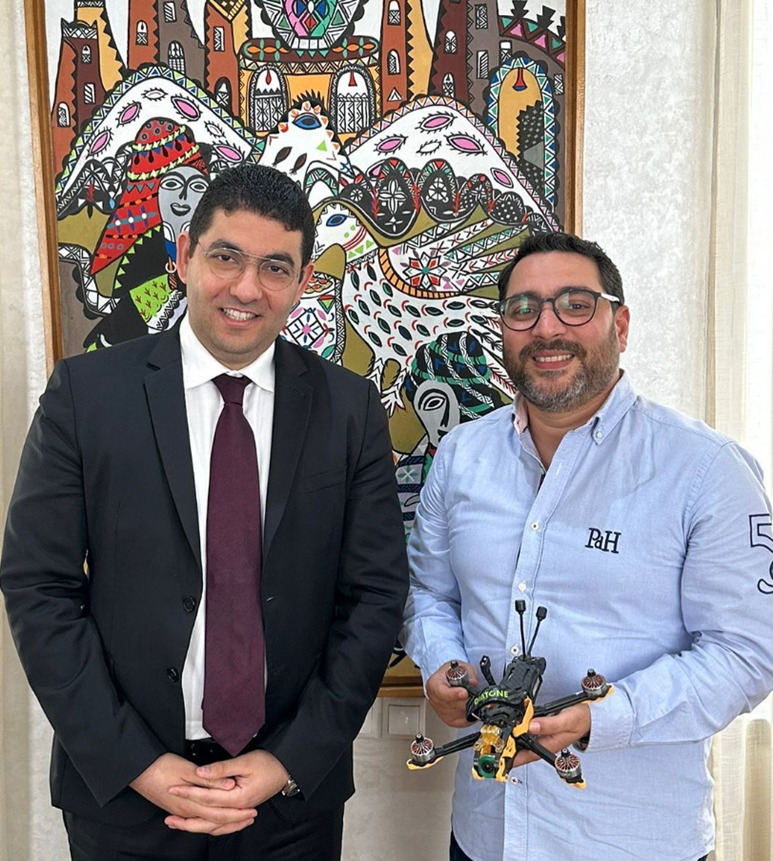
Since its launch in Morocco, Drone Soccer has enjoyed the support of Medhi Bensaïd (left), Morocco’s Minister of Youth, and Abdesslam Mekouar (right), president of Drone Soccer Morocco. © dronesoccermorocco
Since 2023, Drone Soccer has taken root on the African continent, starting in Morocco. Behind this innovative initiative on a rapidly developing continent, Abdesslam Mekouar spoke about the barriers hindering the sport’s growth in Morocco, as well as his solutions.
A drone pilot for 14 years, Abdesslam Mekouar first discovered Drone Soccer in 2021 at a trade show in Dubai. While working as an instructor for drone pilots, he met Pascal Roignau, president of Drone Soccer France, and Lee Bum Su, one of the founding members of FIDA: “When I saw that Drone Soccer booth, I was obviously intrigued. As someone who knew drones inside out, this sport broke all the rules. Pascal Roignau and Lee Bum Su came to meet me, and I quickly became interested in the history and values of the sport. I came home with a whole bunch of ideas!” exclaims the former pilot.
“Here, drones are seen more as a professional tool than a hobby.”
But upon returning to Morocco, Abdesslam’s ambitions were confronted by the realities surrounding drones in the country. While drones initially gained popularity as a hobby, their development is now shifting toward the professionalisation of the sector. These are barriers specific to Morocco that inevitably hinder Abdesslam’s projects: “Before launching Drone Soccer Morocco in 2023, I encountered quite a few obstacles along the way. Here, drones are seen more as a professional tool than a hobby. It is a costly and highly regulated field. While the government is investing heavily in drones, the share of investment dedicated to recreational use remains too small to make it accessible to everyone,” laments the Moroccan.
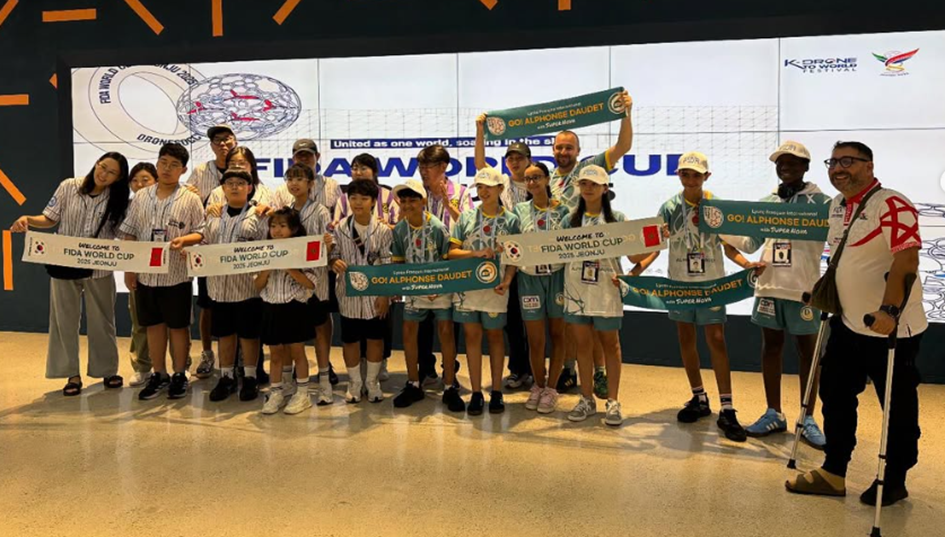
The French Alphonse Daudet School was the first team to join Abdesslam’s program, here at the 2025 World Cup in Jeonju, South Korea © dronesoccermorocco
Every problem has a solution
To adapt to this challenging situation, Abdesslam Mekouar carefully studied the regulations of the DAC (Civil Aviation Authority) and drew inspiration from the Korean model. He developed indoor drone soccer to circumvent outdoor flight bans and focused his efforts on young people. His vision is simple: to adapt Drone Soccer to the school environment and view the sport as a means of learning rather than just playing. This approach caught the attention of Medhi Bensaïd, Morocco’s Minister of Youth and Culture. Thanks to his support, Abdesslam’s plans have taken shape: adapting the sport for schools and training young people in STEM (Science, Technology, Engineering and Mathematics). “In Morocco, drones remain a hobby that is still too inaccessible. Drone Soccer can change that. The Ministry of Youth provides us with tremendous support for our events in schools. It’s a fun way to integrate STEM into a programme that young people take seriously and are committed to. In fact, it was at the Alphonse Daudet French School in Casablanca that we created the country’s first Drone Soccer club, made up entirely of young people, which represents us in international competitions,” Abdesslam says with enthusiasm.
A Model to Follow in Africa
Since 2025, only one other nation, Nigeria, has joined Abdesslam and Morocco on the IFDA African Committee. Thanks in large part to the competitive scene, drone soccer is gaining momentum across Africa: Cameroon, South Africa, Côte d’Ivoire, Senegal, and Tunisia—all these nations are taking an interest in this discipline that combines learning, sport, and innovation. The only downside, according to Abdesslam, is that the African continent needs support, training, and guidance from IFDA in its development: “Just as the Koreans did with us, FIDA must train these teams, make them self-sufficient, and provide them with equipment… Even if this comes at a certain cost, these countries are ready to make a long-term commitment to developing Drone Soccer in their regions. We just need to promote the sport through various channels—media, events, and communication—so that people understand that Drone Soccer is the sport of the future. It’s not just a game; it’s a 100% STEM sport based on coding, learning, and above all, competition!” After three years in existence, Drone Soccer Morocco is taking on a whole new dimension on the competitive scene, having organised the first Inter-School Drone Soccer Open in Casablanca last May. An event true to Abdesslam’s vision, which highlights school teams but can serve as a foundation for expanding competitions across the entire continent.